Introduction
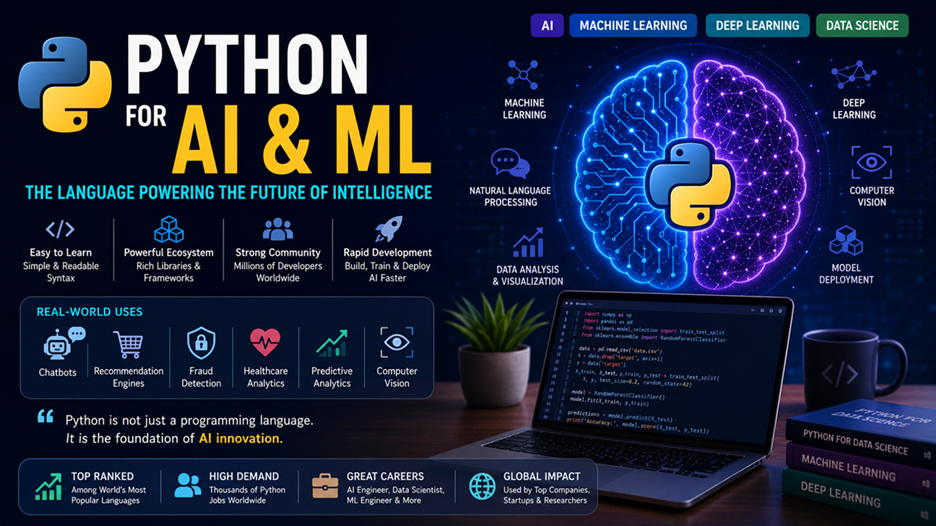
Python has become the most important programming language in the world of Artificial Intelligence and Machine Learning. From startups building AI products to global enterprises deploying large-scale intelligent systems, Python powers modern innovation across industries.
Today, Python is used in AI chatbots, recommendation engines, fraud detection systems, healthcare analytics, automation platforms, robotics, computer vision systems, and Generative AI applications. Its simplicity, massive ecosystem, and strong developer community have made it the default language for AI and ML development.
Python at a Glance
Python is a high-level, interpreted, open-source programming language created by Guido van Rossum and first released in 1991. The language was designed with readability and simplicity in mind, making it easier for developers to write and maintain code.
- Language Type: High-level interpreted language
- First Release: 1991
- Creator: Guido van Rossum
- License: Open-source
- Popular Uses: AI, ML, Data Science, Automation, Web Development, APIs
One of Python’s biggest strengths is its beginner-friendly syntax. Developers can focus more on solving problems and building intelligent systems rather than dealing with complex syntax rules.
print("Hello AI World")This simplicity allows students, developers, researchers, and AI engineers to rapidly experiment with machine learning models and AI applications.
Why Python is Popular for AI and Machine Learning
Python dominates AI and ML development because it combines simplicity with an incredibly powerful ecosystem. Developers can build prototypes, train models, analyze data, and deploy intelligent applications faster than many other languages.
- Simple and readable syntax
- Large AI and ML library ecosystem
- Massive global developer community
- Rapid prototyping capability
- Cross-platform support
- Excellent integration with data science tools
Python also integrates well with cloud platforms, APIs, databases, enterprise systems, and modern AI frameworks. This flexibility makes Python ideal for startups, enterprises, universities, and research organizations.
Python Global Ranking and Popularity
Python consistently ranks among the top programming languages globally. It is widely adopted across industries including software development, data science, automation, finance, cybersecurity, cloud engineering, and AI research.
Developers prefer Python because of its ease of learning, flexibility, and productivity. Universities worldwide teach Python as a primary language for programming and AI education.
- Widely used in startups and enterprises
- Popular in AI research communities
- Strong adoption in universities and education
- Preferred language for AI prototyping
- High developer demand globally
Major technology companies including Google, Meta, Microsoft, Netflix, Amazon, OpenAI, and Spotify use Python extensively for AI and data-driven systems.
Python Community and Ecosystem
Python has one of the strongest developer communities in the world. Its open-source ecosystem continuously contributes libraries, frameworks, learning resources, tutorials, and tools that support innovation.
The Python ecosystem allows developers to solve complex problems using ready-made tools instead of building everything from scratch.
- Millions of open-source packages
- Large GitHub contribution ecosystem
- Strong Stack Overflow support
- Global tutorials and forums
- Continuous framework innovation
Whether you are a beginner learning AI or an enterprise architect building scalable AI systems, the Python community provides enormous support.
Python in Artificial Intelligence and Machine Learning
Python is deeply integrated into modern AI and ML workflows. AI engineers use Python for data preprocessing, feature engineering, model training, deployment, automation, and experimentation.
- Machine Learning
- Deep Learning
- Natural Language Processing
- Computer Vision
- Predictive Analytics
- AI Model Deployment
from sklearn.linear_model import LinearRegression

model = LinearRegression()
print("Machine Learning Model Ready")
Python enables developers to build machine learning pipelines quickly while integrating with cloud services, APIs, and enterprise applications.
Popular Python Libraries for AI and ML
Python’s AI ecosystem is powered by powerful open-source libraries that simplify machine learning, data analysis, and deep learning workflows.
- NumPy – Numerical computing and arrays
- Pandas – Data analysis and manipulation
- Matplotlib – Data visualization
- Scikit-learn – Traditional machine learning
- TensorFlow – Deep learning framework
- PyTorch – AI research and neural networks
- Keras – Simplified deep learning APIs
- OpenCV – Computer vision applications
- NLTK and spaCy – Natural Language Processing
These libraries reduce development complexity and help developers focus on solving business problems rather than building low-level infrastructure.
Real-World Uses of Python in AI and ML
Python powers some of the most impactful AI applications in the world today.
- AI chatbots and virtual assistants
- Recommendation systems
- Fraud detection platforms
- Healthcare diagnostics and analytics
- Stock market prediction systems
- Automation and scripting
- Image and face recognition
- Predictive business analytics
For example, streaming platforms use Python-powered recommendation engines to personalize user experiences, while banking systems use AI models to detect suspicious transactions.
Python Jobs and Career Opportunities
Python skills are among the most demanded technical skills in the job market today. Companies across industries hire professionals who understand Python, data analysis, machine learning, and AI systems.
- Python Developer
- Machine Learning Engineer
- AI Engineer
- Data Scientist
- NLP Engineer
- Automation Engineer
Python creates beginner-friendly entry points into AI careers because developers can quickly start building projects and experimenting with real-world datasets.
Python vs Other Programming Languages
Although multiple programming languages support AI development, Python remains the preferred choice because of its ecosystem maturity and ease of use.
- Java: Strong enterprise backend language but more verbose for AI experimentation
- R: Excellent for statistics but less versatile for production AI systems
- JavaScript: Useful for web AI integration but limited AI ecosystem
- C++: High performance but more complex for rapid AI development
Python balances simplicity, performance, scalability, and ecosystem support better than most alternatives.
Practical Learning Roadmap for Beginners
Students and developers who want to enter AI and Machine Learning can follow a structured roadmap to gradually build expertise.
- Learn Python basics and syntax
- Understand data structures and functions
- Practice NumPy and Pandas
- Study machine learning fundamentals
- Build AI and ML projects
- Learn APIs and deployment
- Create GitHub portfolio projects
Consistent project building and practical learning are more important than only watching tutorials.
Future of Python in AI
As Generative AI, Agentic AI, robotics, automation, and intelligent systems continue to grow, Python is expected to remain one of the most important programming languages globally.
The rapid growth of LLM frameworks, AI agents, MLOps platforms, and cloud AI services continues to strengthen Python’s dominance in the AI ecosystem.
Conclusion
Python has become the backbone of modern Artificial Intelligence and Machine Learning because it combines simplicity, scalability, flexibility, and an unmatched ecosystem. Whether you are a student, software engineer, researcher, or future AI architect, learning Python opens doors to some of the fastest-growing technology careers in the world.
From machine learning and deep learning to Generative AI and intelligent automation, Python continues to power the future of intelligent systems.